
Buying a motorcycle helmet can be confusing when one brand calls your size Medium and another calls it Large.
The reason is simple: motorcycle helmet sizes are not the same across every brand. A size chart helps you choose where to start, but you still need to try the helmet on to make sure it fits.
This guide compares official helmet size charts from HJC, STUDDS, SMK, and SHOEI. It also explains how to measure your head at home, what to do if you’re between sizes, and why the number on the tape measure isn’t the whole story.
Motorcycle Helmet Size Chart: Compare Popular Brands
The table below shows head measurements from four brands. All measurements are in centimeters (cm).
| Helmet size | HJC | STUDDS | SMK | SHOEI |
|---|---|---|---|---|
| XS | 54–55 cm | 54–56 cm | 54 cm | 53–54 cm |
| S | 55–56 cm | 56–57 cm | 55 cm | 55–56 cm |
| M | 57–58 cm | 57–58 cm | 57 cm | 57–58 cm |
| L | 58–59 cm | 58–60 cm | 59 cm | 59–60 cm |
| XL | 60–61 cm | 60–62 cm | 61 cm | 61–62 cm |
| XXL / 2XL | 62–63 cm | 62 cm | 62 cm | 63–64 cm |
Sources: HJC official size chart, STUDDS official size chart, SMK official size chart, and SHOEI official size chart.
Charts checked: October 16, 2026.
Important: SMK lists a single head measurement for each size, not a measurement range. These are the values shown on its chart, not a promise that only that exact head size will fit.
The table also covers only the sizes shared by all four charts. Each brand may offer additional sizes.
Use this comparison to understand the differences between brands. For the helmet you’re buying, always check the size chart for that particular model.
Why the same head measurement can mean different sizes
Suppose your head measures 56 cm.
According to the charts above:
- HJC places 56 cm in Small.
- SHOEI also places 56 cm in Small.
- STUDDS includes 56 cm in both Extra Small and Small.
- SMK lists 55 cm for Small and 57 cm for Medium, without giving a full range for either.
This doesn’t mean one company is wrong. Helmet makers use different sizing systems, and their helmets can have different shapes and padding.
It also shows why you shouldn’t buy a helmet just because your old one was a Medium.
How to Measure Your Head for a Motorcycle Helmet
You only need a soft measuring tape and a mirror. Having someone help can make the measurement easier.
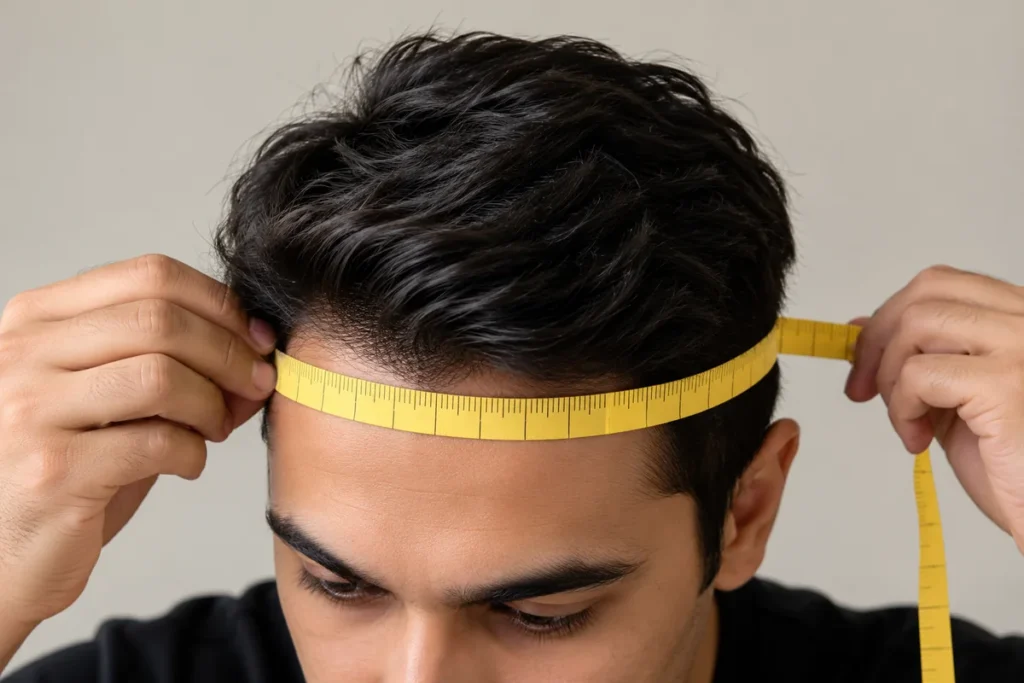
Step 1: Place the tape above your eyebrows
Wrap the tape around your head, roughly 1 inch (2.5 cm) above your eyebrows. Bring it around the widest part at the back of your head.
Keep the tape level rather than letting it slope down at the back.
Step 2: Keep the tape snug
The tape should sit against your head without squeezing it.
Don’t leave it loose, and don’t pull it so tightly that it digs into your skin.
Step 3: Check the measurement again
Move the tape up and down slightly to find the largest reading, and measure twice. Bell advises using the larger of the two readings.
Write down the result in centimeters. If your tape shows inches, you can convert the measurement using:
1 inch = 2.54 cm
For example, 23 inches is about 58.4 cm.
Step 4: Compare it with the correct size chart
Find the official chart for the helmet brand and model you want.
If your measurement falls near the edge of a size range, plan to try more than one size.
Remember: The measurement helps you pick a starting size. It cannot tell you whether the helmet will feel right on your head.
HJC Motorcycle Helmet Size Chart
HJC publishes a size chart with measurements in centimeters and inches. It also includes hat sizes.
Here are the centimeter ranges from HJC’s official chart:
| Size | Head measurement |
|---|---|
| 3XS | 50–51 cm |
| 2XS | 52–53 cm |
| XS | 54–55 cm |
| S | 55–56 cm |
| M | 57–58 cm |
| L | 58–59 cm |
| XL | 60–61 cm |
| 2XL | 62–63 cm |
| 3XL | 64–65 cm |
| 4XL | 66–67 cm |
| 5XL | 68–69 cm |
Notice that some ranges overlap. For example, 55 cm appears in both XS and S, while 58 cm appears in both M and L.
HJC says its chart is a reference and recommends trying the helmet on before deciding.
Official source: HJC Helmet Size Chart
STUDDS Motorcycle Helmet Size Chart
STUDDS is a familiar helmet brand for many riders in India. Its official chart uses centimeters.
| Size | Head measurement |
|---|---|
| XXXS | 50–52 cm |
| XXS | 52–54 cm |
| XS | 54–56 cm |
| S | 56–57 cm |
| M | 57–58 cm |
| L | 58–60 cm |
| XL | 60–62 cm |
| XXL | 62 cm |
The chart includes overlapping measurements at some size boundaries.
STUDDS also advises riders to try the helmet with the chin strap fastened and check that it doesn’t move separately from the head.
Official source: STUDDS Helmet Sizing Chart
SMK Motorcycle Helmet Size Chart
SMK’s chart works a little differently. Instead of giving a range for each size, it lists individual head measurements.
| Size | Listed head measurement |
|---|---|
| Y-S | 48 cm |
| Y-M | 50 cm |
| Y-L / XXS | 52 cm |
| XS | 54 cm |
| S | 55 cm |
| M | 57 cm |
| L | 59 cm |
| XL | 61 cm |
| XXL | 62 cm |
| XXXL | 64 cm |
| XXXXL | 65 cm |
The Y sizes are youth labels on SMK’s chart.
Because these are individual values, don’t assume that the missing centimeters automatically belong to the nearest size.
SMK also recommends trying the helmet before buying.
This is the chart on SMK’s global site. SMK also has a separate North American site, so US buyers should check the chart there.
Official source: SMK Helmet Sizing Chart
SHOEI Motorcycle Helmet Size Chart
SHOEI provides an official size chart with head measurements in centimeters, inches, and hat sizes.
| Helmet size | Hat size | Head measurement (cm) | Head measurement (inches) |
|---|---|---|---|
| XS | 6⅝–6¾ | 53–54 cm | 20⅞–21¼ |
| S | 6⅞–7 | 55–56 cm | 21⅝–22 |
| M | 7⅛–7¼ | 57–58 cm | 22½–22⅞ |
| L | 7⅜–7½ | 59–60 cm | 23¼–23⅝ |
| XL | 7⅝–7¾ | 61–62 cm | 24–24⅜ |
| XXL | 7⅞–8 | 63–64 cm | 24¾–25⅛ |
| XXXL | 8⅛–8¼ | 65–66 cm | 25⅝–26 |
Source: SHOEI Official Helmet Size Chart
Chart checked: October 16, 2026
For example, if your head measures 58 cm, SHOEI’s chart points to Medium. If it measures 60 cm, the chart points to Large.
SHOEI recommends measuring around your head about 1 inch (2.5 cm) above your eyebrows, moving the tape slightly up and down to find the largest measurement.
If you’re between two sizes, SHOEI’s fitting guide says to try the smaller helmet first, then check that it fits snugly all around without sharp pressure points. The size chart is a starting point, not a guarantee of fit.
Always follow the sizing instructions for the specific SHOEI helmet you’re considering.
Bell Motorcycle Helmet Size Charts
Bell publishes its motorcycle helmet size charts by model, with head circumference, hat size, and cheek pad measurements. It also advises measuring twice and using the larger of the two readings.
That matters because you shouldn’t assume every Bell helmet uses exactly the same sizing.
Official source: Bell Motorcycle Helmet Size Charts
Before ordering a Bell helmet, open the chart for the model you’re considering.
What If You’re Between Two Helmet Sizes?
Let’s say your head measures 58 cm and the manufacturer’s chart places that measurement at the edge of two sizes.
Don’t choose the larger one just because it feels easier to put on. SHOEI’s fitting guide says that if your measurement falls between two sizes, you should try the smaller helmet first. Other brands may give different advice, so follow the guidance for the helmet you’re buying.
Try both sizes if you can.
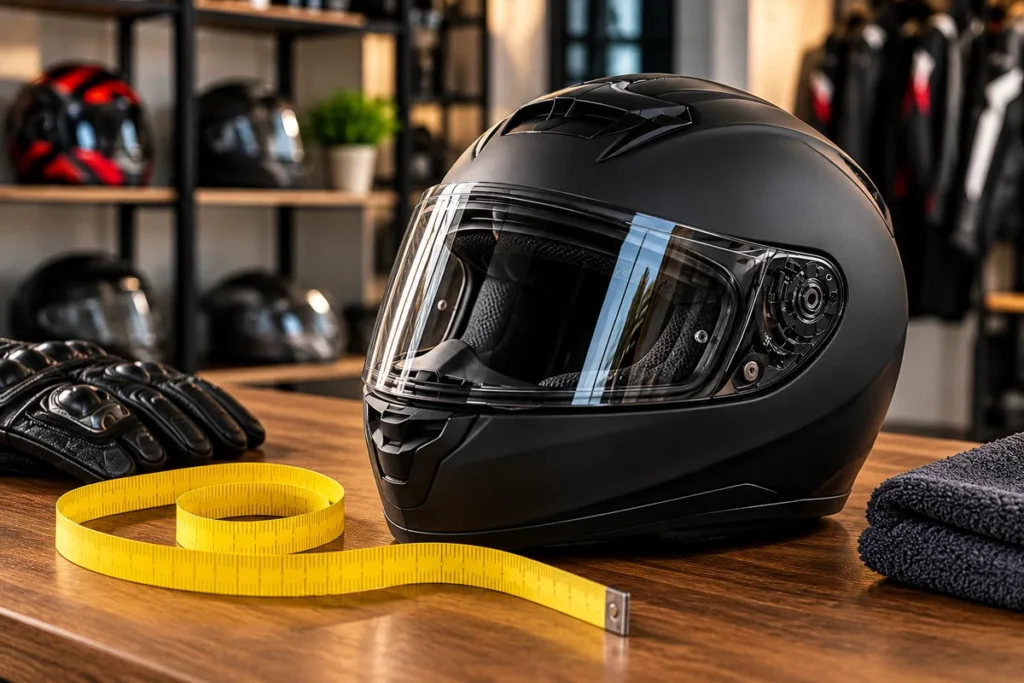
A new helmet should feel snug, but it shouldn’t cause painful pressure on your forehead or the sides of your head.
If neither size fits comfortably and securely, a different helmet model may suit your head better.
Does Head Shape Matter When Choosing a Helmet?
Yes. Two people can have the same head measurement but need different helmet models.
One person may have a rounder head, while another has a longer, narrower head. A helmet that fits one person comfortably may press painfully against the other’s forehead or temples.
This is why a size chart alone can’t guarantee a good fit.
If a helmet causes sharp pressure in one area, don’t assume the problem will disappear after a few rides. Try a different size or a model with a different internal shape.
The NHTSA motorcycle helmet fitting guide describes three head shapes (round oval, intermediate oval, which is the most common, and long oval). It says pressure on the forehead suggests a helmet that is too round, and pressure at the sides suggests one that is too oval.
How to Check That Your Motorcycle Helmet Fits
Once you’ve chosen a size from the chart, put the helmet on and fasten the chin strap.
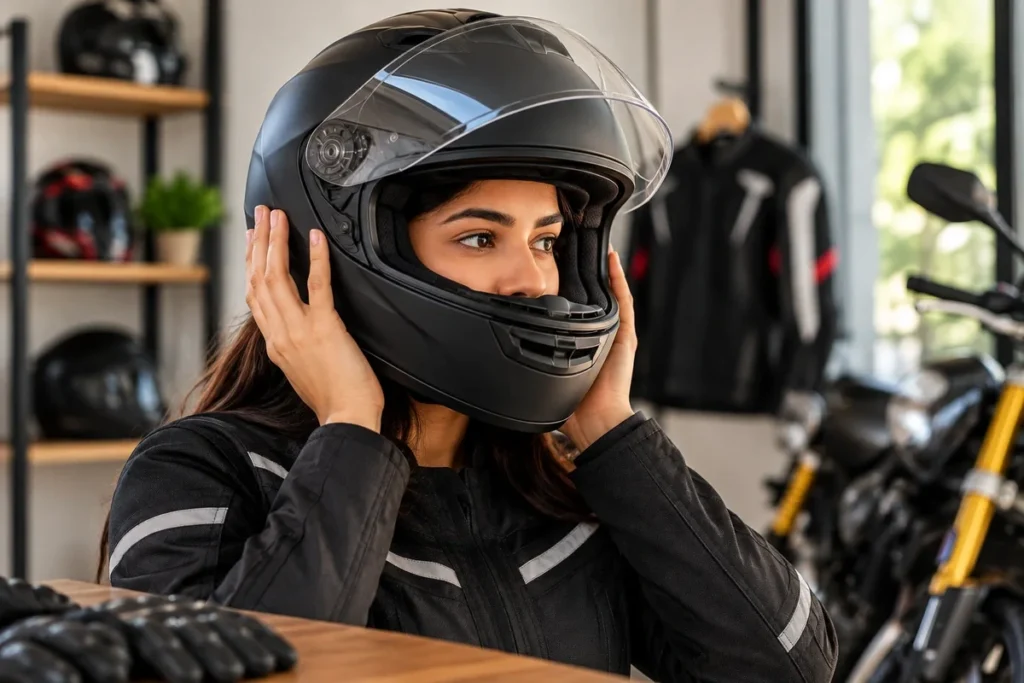
Check these basics:
- The helmet should sit properly on your head, not perched high above it.
- The padding should feel snug around your head and cheeks.
- You shouldn’t feel sharp or painful pressure in one spot.
- When you gently move the helmet from side to side, it shouldn’t slide freely over your head.
- With the strap secured, the helmet should stay in place during the manufacturer’s recommended movement checks.
For the full checklist, read my guide on how a motorcycle helmet should fit.
NHTSA advises wearing a new helmet at home for 30 to 45 minutes before your first ride, because pressure points can take time to show.
If you’re replacing an older helmet, my guide on how long motorcycle helmets last explains why age, condition, and previous impacts matter too.
Common Motorcycle Helmet Sizing Mistakes
Buying the same size in every brand
A Medium from one brand may not fit like a Medium from another. Always check the current chart.
Measuring too low on the forehead
Placing the tape too low or at an angle can give you the wrong measurement. Keep it level and follow the manufacturer’s instructions.
Choosing a loose helmet for comfort
A loose helmet may feel comfortable in the shop but can move too much when you turn your head.
Ignoring painful pressure
A helmet should be snug, not painful. A strong pressure point can mean the size or shape is wrong.
Buying a used or borrowed helmet
HJC advises against buying a used helmet. A used helmet’s impact history is unknown, and its padding and foam have already adapted to someone else’s head, so it’s unlikely to fit you the way the chart suggests.
Ordering without checking the exact model
Some manufacturers publish different charts for different models. Check the one you’re buying, especially when shopping online.
Frequently Asked Questions
What size motorcycle helmet do I need for a 58 cm head?
It depends on the brand and model. HJC’s general chart includes 58 cm in both Medium and Large, and so does STUDDS’s. SHOEI’s chart places 58 cm in Medium. SMK lists individual measurements rather than full ranges, so check its model guidance and try the helmet on.
Is a 60 cm motorcycle helmet Large or Extra Large?
There is no single answer. STUDDS includes 60 cm in both Large and XL, HJC’s chart places it in XL, and SHOEI’s chart places it in Large. Check the chart for the helmet you’re buying.
Can I measure my head without a measuring tape?
Yes. Wrap a piece of non-stretch string around your head, mark where it meets, and measure the string with a ruler. A soft measuring tape is usually easier and less likely to slip.
Should I buy a bigger motorcycle helmet if I’m between sizes?
Not automatically. Try the sizes suggested by the manufacturer and check how each fits. A helmet that’s too loose is not a safe solution to discomfort.
Are men’s and women’s motorcycle helmet sizes different?
Don’t choose a helmet based on a men’s or women’s label alone. Measure your head and use the size chart for the exact helmet model. Head shape and fit matter more than the label.
Do motorcycle helmets get looser over time?
The comfort padding can settle with use, so a new helmet may feel different after you’ve worn it for a while. But a helmet that is painfully tight or clearly the wrong shape isn’t something you should simply wait to fix itself.
Final Thoughts
The best way to choose a motorcycle helmet size is to measure your head, check the manufacturer’s chart, and try the helmet on.
Don’t rely on a size label alone. A Medium in one brand may fit differently from a Medium in another, and even helmets from the same brand can have different shapes.
Take the time to find a helmet that sits securely, feels snug all around, and doesn’t create painful pressure points. A few extra minutes checking the fit are worth it.