There is something about a matte black helmet that just works on a motorcycle. It looks clean, understated and easy to pair with almost any bike.
But looks should be the easy part of choosing a helmet.
Before worrying about matte or gloss, I would look at the helmet itself: the right fit, the type of helmet, visibility, comfort, ventilation and the certification that applies where you ride. Once those things are right, choosing matte black comes down to personal preference.
If you’re deciding between the two finishes, my matte vs gloss helmet comparison explains the differences in appearance, cleaning, scratches, and everyday care.
That is what Matte Black Helmets is about. This site focuses on matte black motorcycle helmets, the brands that make them, how different models compare, and the practical side of owning one.
Where I have personal experience with a helmet, I’ll say so. For helmets I haven’t used, I’ll keep the information clearly based on research and published specifications.
What Is a Matte Black Helmet?
A matte black helmet (also written “matt black”) is simply a motorcycle helmet with a black, non-glossy exterior finish.
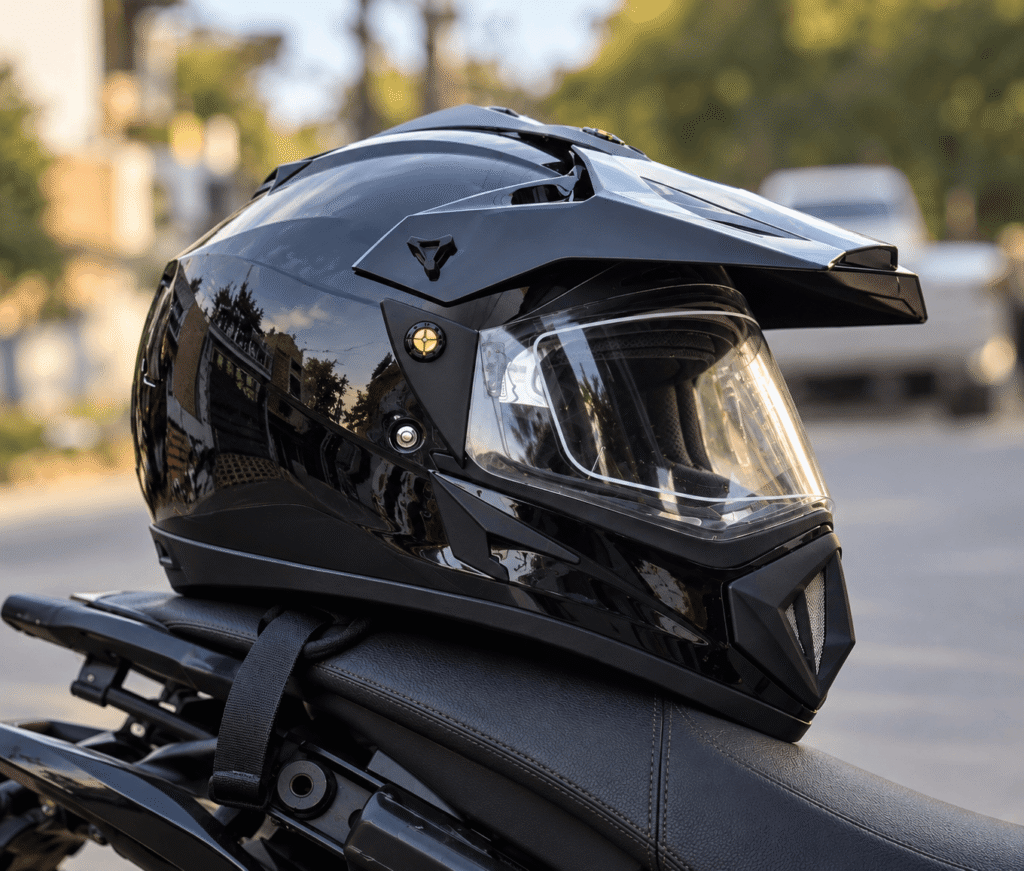
The word “matte” describes the surface. It does not tell you what the shell is made from, how the helmet fits, what features it has or how well it suits your riding.
You can find the finish on full-face, modular, open-face and off-road helmets, from basic everyday models to much more expensive options.
So I would not choose a helmet just because it is matte black. I would find the right helmet first and then see whether that model is available in the finish I want.
Why Choose Matte Black?
Mostly because you like how it looks. That is a perfectly good reason to choose a color.
Matte black has a flatter, less reflective appearance than gloss black. It tends to look simple rather than flashy, and it works with almost any motorcycle color. If you change bikes later, a plain matte black helmet is unlikely to suddenly look out of place.
The trade-off is that the finish deserves a little care. A product that is fine for a glossy painted surface may not be a good idea on matte paint. Polishes and waxes are the obvious examples: anything designed to add shine can leave a matte surface looking uneven.
That does not make matte black difficult to own. It just means you should clean it like a matte finish rather than treating it as gloss.
Matte Black vs Gloss Black Helmets
If you are choosing between matte and gloss versions of the same helmet, most of the decision is about appearance and maintenance. The finish itself does not turn one version into a fundamentally different helmet.
| Point | Matte Black | Gloss Black |
| Appearance | Flat, low-shine finish | Smooth, reflective finish |
| Style | Understated and simple | Shinier and more noticeable |
| Polishing | Usually best avoided unless specifically approved | Some glossy finishes may accept suitable polish |
| Minor marks | Can be awkward to correct without changing the finish | Some surface marks may be easier to improve, depending on coating |
| Cleaning | Gentle cleaning matters; avoid shine-producing products | Still needs proper cleaning, but uneven shine is less of a concern |
| Safety | Finish itself does not determine safety | Finish itself does not determine safety |
I would not call one finish universally better. If you like the flatter look, choose matte. If you prefer a deeper shine, gloss may suit you better.
How to Choose a Matte Black Helmet
It is easy to start with the helmet that looks best. I would do it the other way around: narrow down the helmets that make sense for you, then choose the finish.
1. Start With the Helmet Type
Think about where you actually ride. A rider doing short city trips may care about different things from someone who spends hours on highways or regularly rides rough roads.
Once you know the type of helmet you want, comparing matte black options becomes much easier because you are no longer comparing completely different designs.
2. Check the Certification That Applies to You
The certification you need depends on where you ride. In the US, motorcycle helmets for road use are expected to meet FMVSS 218 and carry the DOT mark. In Europe and many other countries, look for ECE 22.06. In India, BIS identifies IS 4151:2015 as the standard for motorcycle helmets, and the 2020 Quality Control Order requires covered two-wheeler helmets to bear the Standard Mark under a BIS license. Check your local rules, because they change.
I would keep this practical: do not rely only on a marketplace title saying “DOT,” “ECE,” or “ISI.” Check the actual model and the information supplied by the manufacturer or another authoritative source.
Certification matters, but it is not a promise that injury is impossible. It is one important part of choosing a helmet, not a substitute for correct fit and proper use.
3. Measure Your Head
Do not assume you are a Medium because your previous helmet was a Medium.
Measure your head and compare that measurement with the size chart for the specific helmet. Sizing can differ between brands and even between models.
A size chart gets you into the right area, but it cannot tell you everything. Head shape and internal padding also affect how a helmet feels.
4. Pay Attention to Fit
A helmet should feel secure rather than loose. New padding can feel snug, but snug and painful are not the same thing.
If you feel a strong pressure point that does not settle, or the helmet moves around too easily when you move your head, do not ignore it just because the design looks good.
For a simple way to check the fit, read my guide on how a motorcycle helmet should fit.
5. Look at Visibility and the Visor
A good-looking helmet is not much use if you dislike looking through it.
Check the visor setup, field of view and whether replacement visors are easy to find. Some helmets include an internal sun visor, which can be useful if you regularly ride in bright conditions.
Features such as anti-fog compatibility can also matter depending on when and where you ride. I would rather have a few features I actually use than a long specification list that looks impressive online.
6. Think About Ventilation
Ventilation is difficult to judge from photographs. The number of vents does not automatically tell you how a helmet will feel in real riding.
Look at the position of intake and exhaust vents and whether they can be operated easily. For hot-weather riding or longer trips, this can matter more than it first appears.
7. Consider Weight, But Do Not Chase One Number
Weight is worth checking, especially if you wear a helmet for long periods.
But a specification-sheet number is not the whole comfort story. Fit, balance, padding and riding position can change how the helmet feels on your head.
I would use weight as one comparison point, not automatically buy the lightest option.
8. Check the Liner, Buckle and Replacement Parts
A removable and washable liner is useful, particularly in warm or dusty conditions. The fastening system should also be easy for you to use correctly every time.
One thing that is easy to forget is replacement parts. Before buying, it is worth checking whether replacement visors and other model-specific parts are actually available. That becomes much more important after you have owned the helmet for a while.
9. Choose the Matte Black Finish
Now we get to the part this website is named after.
Once the important things check out, choose the color you actually want to wear. You do not have to pretend appearance does not matter. Just put it in the right place on the list.
Types of Matte Black Motorcycle Helmets
Matte black is a finish, so you will find it across several helmet styles. The right style depends on your riding rather than the color.
Full-Face Helmets
A full-face helmet encloses the head and includes a fixed chin section. It is one of the most common styles for road riding, and there are plenty of matte black choices. When comparing them, look at fit, visor design, ventilation, liner, weight and the specific model’s certification rather than judging by shell shape alone.
Modular Helmets
A modular or flip-up helmet has a movable chin section. The convenience is obvious for riders who want easier face access when stopped. Check the manufacturer’s instructions for how the chin section is intended to be used rather than assuming every modular helmet is designed to be ridden open.
Open-Face Helmets
Open-face helmets leave the face and chin area open. Some riders prefer the more open feel for certain kinds of city riding. The obvious trade-off is that there is no full chin bar in front of the face.
Off-Road and Adventure-Style Helmets
These helmets often have a pronounced chin area and a peak, with visor or goggle arrangements depending on the design. My own Vega Off Road falls into this general style, although my personal use has mainly been normal road riding rather than off-road riding.
My Experience With the Vega Off Road Helmet
My current helmet is black, but it is gloss rather than matte.
I have been using a Vega Off Road full-face helmet with a dual visor and peak for about two years. It was a gift, and I have used it mainly for city rides. For me, the fit is good and it does not feel particularly heavy. That is personal experience, not a claim that every rider will feel the same. I haven’t judged its visor, noise, or ventilation on long highway rides.
Vega’s current Off Road D/V listing describes a high-impact ABS shell, dual visor, removable and washable lining, multiple vents, a quick-release micrometric buckle and ISI certification (India’s standard mark). Vega lists the weight as 1190 ± 50 grams and currently shows both Black and Dull Black color options.
Mine is the glossy black version. So I can talk about wearing my own helmet, but I cannot use it as evidence for how the Dull Black finish ages, how easily it marks or how it compares with another brand’s matte coating.
As I use more matte black helmets, I’ll add my own photos and longer-term notes where they are useful.
City Riding vs Longer Rides
For City Riding
On short, stop-and-go rides, small usability details can matter a lot. I would pay attention to visibility, ventilation at lower speeds, how easily the visor operates and how simple the buckle is to use when you are taking the helmet on and off regularly.
An internal sun visor can also be useful if your riding often moves between bright sunlight and shade.
For Highway and Longer Rides
Longer rides expose things you may not notice during a five-minute try-on. Fit, pressure points, airflow, visor performance, balance and noise become more noticeable over time.
This is where hands-on experience becomes especially useful. A specification sheet can tell you a helmet’s listed weight. It cannot tell you whether your particular head will still feel comfortable after two hours.
Are Matte Black Helmets Hard to Maintain?
Not really, but I would treat the finish gently.
With matte paint, the aim is to remove dirt without adding shine or changing the texture. For normal cleaning, start with a clean, soft cloth and follow the helmet manufacturer’s instructions where available.
I would avoid reaching for polish, wax or an abrasive cleaner simply because it works on another painted surface. A stubborn mark is not worth creating a permanent shiny patch around it.
For a step-by-step walkthrough, see my guide on how to clean a matte black helmet.
How to Protect a Matte Black Finish
Most finish care is common sense. Do not keep putting the helmet down on rough concrete. Keep keys, tools and other hard objects away from it when carrying or storing it. If the helmet comes with a soft storage bag, use it when appropriate.
Clean bugs and grime before they become difficult to remove, but do not scrub aggressively. If a cleaner is needed, check that it is suitable for the helmet and its finish.
I would also avoid experimenting with household solvents or strong chemicals. The goal is not to make a two-year-old helmet look untouched at any cost; it is to look after the finish without damaging the helmet.
Do Matte Black Helmets Scratch Easily?
There is no honest yes-or-no answer that applies to every matte helmet.
Different helmets use different coatings, and the way the helmet is handled matters. A helmet that is regularly placed on rough surfaces or rubbed against hard objects is naturally more likely to pick up marks.
The tricky part with matte paint is what happens afterwards. Trying to polish a minor mark can change the appearance of the surrounding area. Prevention is usually easier than trying to make damaged matte paint look untouched again.
Already have a few scratches on your helmet? I’ve also written a guide on how to fix scratches on a matte black helmet, including which marks you can deal with at home.
What About Fingerprints and Everyday Marks?
Matte surfaces can show oils and handling marks, although how obvious they are depends on the particular finish and lighting.
I would not obsess over touching the helmet. It is riding equipment, not a display piece. Clean it properly when it needs cleaning rather than constantly applying products to keep it looking new.
Does a Matte Black Helmet Fade?
I would be careful with blanket claims here. The coating, materials, sunlight, storage, age and care can all affect how a helmet looks over time.
What you can control is how you treat it. Do not leave it exposed to harsh conditions unnecessarily, do not experiment with aggressive chemicals, and follow the manufacturer’s care instructions.
Appearance is also not the only reason a helmet may eventually need replacing. Follow the manufacturer’s guidance for the helmet itself rather than keeping it indefinitely just because the paint still looks good.
If you’re unsure when it’s time for a new helmet, I’ve also written a guide on how long motorcycle helmets last.
Does a Black Helmet Feel Hotter?
Black surfaces absorb more incident light than lighter reflective surfaces under comparable conditions, but that basic fact does not tell you exactly how hot your head will feel inside two different helmets.
Helmet construction, insulation, ventilation, airflow, riding speed and whether you are sitting still in traffic all affect comfort.
So I would not choose between two completely different helmets based only on a claim that one color is hotter. If you ride in hot conditions, look closely at ventilation and real-world comfort as well.
I’ve covered this in more detail in my guide on whether black motorcycle helmets get hotter, including what a published temperature test found.
Common Mistakes When Buying a Matte Black Helmet
Buying for color first. I like matte black too, but the finish should not make you accept the wrong fit, wrong helmet type or questionable product.
Assuming your usual size will always fit. Helmet sizing is not perfectly universal. Check my motorcycle helmet size chart to learn how to measure your head and compare sizes across brands. Where possible, try the helmet on before buying.
Trusting a marketplace title without checking. Seller titles can be incomplete or outdated. Verify important specifications and certification claims for the exact model.
Ignoring replacement visors and parts. The helmet may be easy to buy today while a replacement visor is surprisingly hard to find later.
Paying for features you will not use. A longer feature list is not automatically better. Prioritize the things that matter to your riding.
Trying to polish every small mark. On matte paint, aggressive polishing can make a small imperfection more obvious by creating a shiny patch.
Matte Black Helmet Brands
Many helmet manufacturers offer black finishes, but they do not all use the word “matte.” You may also see names such as Dull Black or other brand-specific finish names.
I’m building a Brands section that will look at manufacturers individually, with a focus on the matte or dull-black models they actually offer.
For each brand, I want to answer practical questions: which relevant models are actually offered in matte or dull black, what the manufacturer says about them, what types of helmets are available, and whether replacement parts such as visors are easy to find.
How Helmets Are Covered on This Site
You will see two broad kinds of product coverage here: hands-on experience and research-based coverage.
If I have actually owned or used a helmet, I will say what I used, roughly how I used it and what I personally noticed. Where useful, I will include original photos.
For helmets I have not used, I’ll rely on manufacturer information, relevant official sources and useful owner feedback, and keep that separate from my own experience.
If a manufacturer lists a weight, that is a manufacturer specification unless I personally weigh the helmet. If owners repeatedly mention an issue, that is owner feedback unless I experience it myself.
What Is Coming Next
I’m building four sections: Helmets, Brands, Guides, and Comparisons. Check back as they grow.
Frequently Asked Questions About Matte Black Helmets
Are matte black helmets safer than other colors?
No. Matte black describes the exterior finish; it is not a safety rating. Look at the specific helmet’s certification, fit and suitability for your riding.
Are matte black helmets certified?
Many are. Manufacturers list certain matte or dull-black models as meeting DOT, ECE, or ISI, depending on the market. Check the certification of the exact model rather than assuming it from the color.
Which certification should I look for?
It depends on where you ride: DOT in the US, ECE 22.06 in Europe and many other countries, and ISI in India. Check your local rules and the label on the helmet itself.
Is matte black better than gloss black?
Neither finish is automatically better. Matte black has a flatter look, while gloss black is shiny and reflective. The choice is mainly about appearance and how you prefer to care for the finish.
Can I polish a matte black helmet?
I would not use ordinary polish or wax unless the helmet or finish manufacturer specifically says it is suitable. Products designed to create shine can leave matte paint looking uneven.
For more on waxing, cleaning products, and safe care, see my guide on how to clean a matte black helmet.
How should I clean a matte black helmet?
Start gently with a clean, soft cloth and follow the manufacturer’s care instructions. Avoid abrasive products and do not automatically use wax or polish made for glossy paint.
Do matte black helmets show scratches?
They can show marks, but the result varies with the coating and how the helmet is handled. The main issue is that polishing a mark may change the surrounding matte finish.
Should a new motorcycle helmet feel tight?
It should generally feel secure and snug, but it should not create painful pressure points. Use the manufacturer’s size chart and try the helmet on where possible.
What should I check before buying a motorcycle helmet?
Start with the helmet type, relevant certification and correct fit. Then consider visibility, comfort, ventilation, weight, fastening system, liner and replacement parts. Choose color and finish after those basics.
Does an expensive helmet automatically mean a better helmet for me?
No. A higher price may bring different materials, features or finish, but fit and suitability still matter. Price alone is not a substitute for checking the actual helmet.
Is matte black difficult to maintain?
Not particularly. Matte finishes just need a little more care with cleaning products. Use a soft cloth, follow the manufacturer’s care instructions, and avoid ordinary polish or wax unless it is specifically suitable for a matte finish.