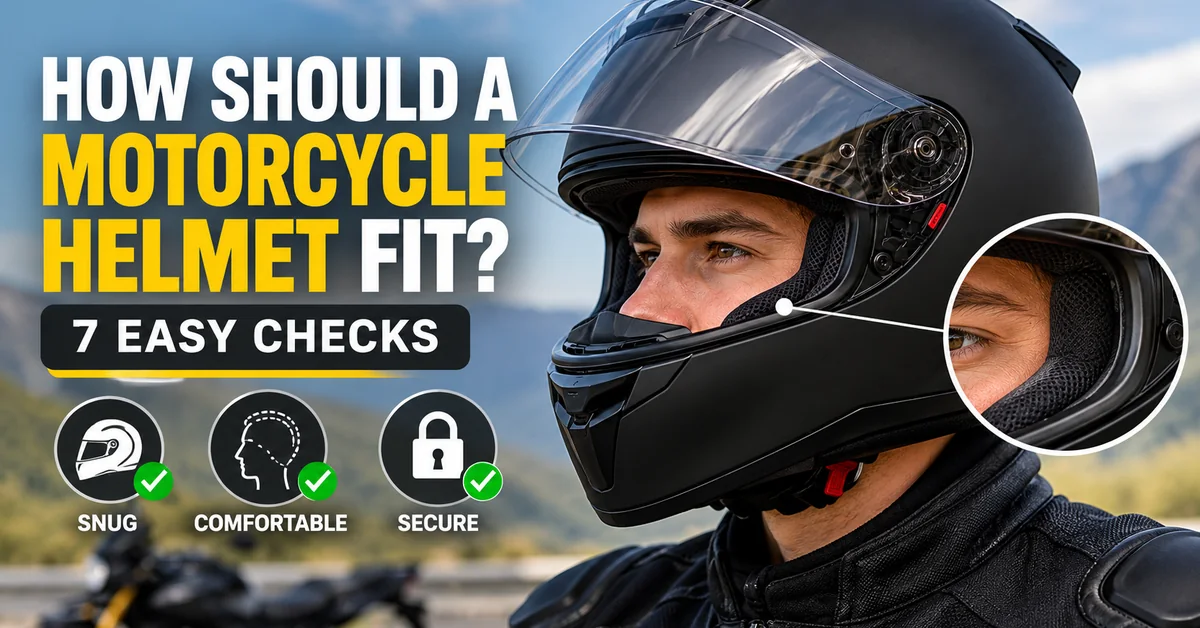
How should a motorcycle helmet fit? Snug, comfortable, and secure. A helmet can look like the right size and still fit badly.
Maybe it feels comfortable when you first put it on, but starts pressing against your forehead after a few minutes. Or perhaps it feels fine until you turn your head and notice the helmet moving around.
Neither is something you should ignore.
A properly fitted motorcycle helmet should feel firm around your head without causing pain. It should stay in place when you move your head, and the cheek pads should make good contact if you’re wearing a full-face helmet.
It shouldn’t slide around. But it shouldn’t feel so tight that you can’t wait to take it off, either.
Here are seven easy checks to help you decide whether your helmet fits.
How Should a Motorcycle Helmet Fit?
A good motorcycle helmet fit comes down to three things:
- Snug: The padding touches your head without leaving loose gaps.
- Comfortable: You feel steady pressure, not sharp pain.
- Secure: The helmet stays in place when you gently try to move it.
A helmet also needs to match your head shape, not just your head measurement. Two helmets labeled Medium may fit very differently.
SHOEI’s fitting guide stresses that proper fit matters for helmet safety, comfort, and keeping the helmet securely on your head.
If you haven’t measured your head yet, start with my motorcycle helmet size chart. It explains how to measure your head and compare sizes across brands.
Once you’ve chosen a size to try, use the checks below.
How Tight Should a Motorcycle Helmet Be?
A new motorcycle helmet should feel tighter than an ordinary hat.
You may need to pull the straps apart slightly to put it on. Once it’s in place, the padding should press firmly against your head.
A little tightness is normal. Pain is not.
If your forehead starts hurting after ten minutes, something isn’t right. The same goes for a helmet that squeezes the sides of your head so much that you develop a headache.
On the other hand, if you can turn the helmet easily while your head stays still, it’s probably too loose.
Don’t choose a bigger helmet simply because it feels more comfortable during the first few seconds. And don’t force yourself to wear a painful one because you expect it to loosen later.
The right fit is snug without painful pressure points.
7 Checks to See Whether Your Motorcycle Helmet Fits Properly
You can do these checks at home or in a helmet shop. Do them standing or sitting still, never while riding.
1. Check How the Helmet Sits on Your Head
Put the helmet on properly and look in a mirror.
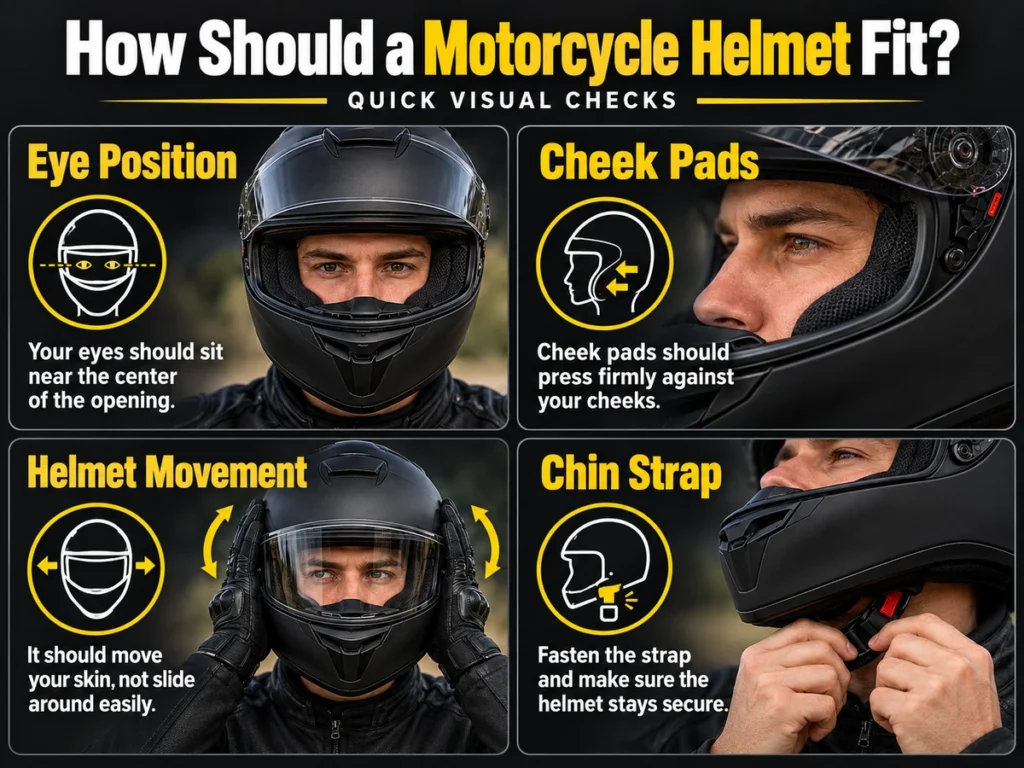
For a full-face helmet, your eyes should sit near the center of the opening. SHOEI says eyes near the top of the opening can suggest the helmet is too big, while eyes low in the opening can suggest it’s too small.
The helmet shouldn’t sit so far back that your forehead is exposed, or so far forward that it blocks your view.
Make sure it’s fully seated on your head.
Don’t assume the size is right simply because you can get the helmet on.
2. Feel the Pressure Around Your Head
Pay attention to the area above your ears, across your forehead, and around the top of your head.
The padding should make firm, fairly even contact.
SHOEI also advises that you shouldn’t be able to easily slide two fingers inside the helmet along your temple. The top pad should press against the top of your head, too.
If you notice one painful spot while the rest feels comfortable, the problem may be the helmet’s shape rather than its size.
For example, a helmet that presses hard against your forehead may not match your head shape.
Trying a different helmet model may work better than simply choosing a larger size.
3. Check the Cheek Pads
This check matters especially with full-face helmets.
The cheek pads should press firmly against your cheeks.
That can feel strange if you’ve never worn a properly fitted full-face helmet before.
SHOEI describes a proper cheek-pad fit this way: when you open and close your mouth, your teeth should drag along the inside of your cheeks.
That doesn’t mean the pads should hurt.
Good signs:
- Your cheeks feel firmly supported.
- The helmet stays steady when you move your head.
- Your teeth brush the inside of your cheeks when you move your mouth, without sharp pain.
Bad signs:
- The pads cause strong pain in your jaw or cheeks.
- The pressure makes it difficult to open your mouth normally.
- Your cheeks barely touch the pads and the helmet feels loose.
Some helmets offer different cheek-pad thicknesses. If yours does, use only the options approved for that specific helmet model.
4. Try the Side-to-Side Movement Test
Fasten the chin strap according to the manufacturer’s instructions.
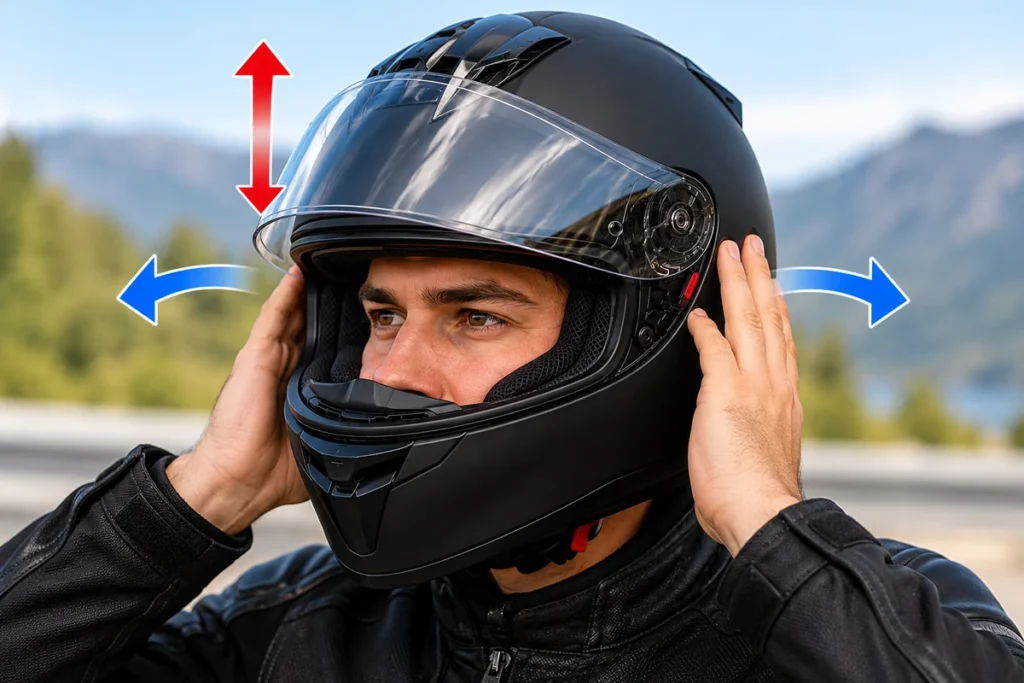
Hold the helmet with one hand on each side. Without moving your head, try to move the helmet up and down and from side to side.
You should feel the skin of your head and face being pulled along. The helmet shouldn’t move easily.
SHOEI says that if the helmet moves around easily without gripping your cheeks, it’s too big.
Don’t use excessive force. You’re checking the fit, not trying to damage the helmet.
5. Check Whether the Helmet Rolls Forward or Backward
Keep the chin strap properly fastened.
Put your hands on the back of the helmet and gently try to push it off by rotating it forward.
Then place your hands on the front and try to rotate it backward.
With the right size, there should be little movement, and the helmet should stay securely in place.
If it rolls forward enough to seriously block your view, moves far backward, or begins to come off, it doesn’t fit securely.
Don’t ride in a helmet that fails this test. Try another size or model.
6. Check the Chin Strap
The chin strap is just as important as the padding.
Buckle it properly and adjust it according to the helmet’s instructions.
It should hold the helmet securely without cutting painfully into your skin.
Check that:
- The buckle is fully closed.
- The strap isn’t twisted.
- There isn’t excessive slack.
- You can move your jaw normally.
Don’t leave the strap loose just because it feels more comfortable.
And remember, a tight chin strap can’t fix a helmet that’s too big around your head.
7. Wear the Helmet for 30 to 45 Minutes
This is one of the most useful checks, and it’s easy to skip.
A helmet may feel fine for the first two minutes. After twenty or thirty minutes, you might notice pressure that wasn’t obvious earlier.
The National Highway Traffic Safety Administration (NHTSA) recommends wearing a new helmet for 30 to 45 minutes to check for pressure points before riding.
Keep it on indoors while sitting or walking around normally.
Pay attention to how you feel.
Does your forehead start to hurt? Do you feel strong pressure near your temples? Are you counting the minutes until you can remove it?
If so, the fit needs another look.
A helmet that stays snug and comfortable throughout this check is a better sign than one that only feels good when you first put it on.
Signs Your Motorcycle Helmet Is Too Tight
A helmet should hold your head firmly, but it shouldn’t cause ongoing pain.
Watch for these signs:
- A headache that develops while wearing it
- Strong pressure against your forehead or temples
- Painful squeezing around your head
- Cheek or jaw pain that doesn’t settle
- A helmet that’s extremely difficult to put on or remove
- Discomfort that keeps getting worse during the indoor fit check
You might be tempted to choose a larger size straight away.
Sometimes that’s the answer. But not always.
If most of the helmet feels right and only one part hurts, try a different model with a shape that better suits your head.
A larger helmet could remove the painful spot while leaving too much room elsewhere.
Signs Your Motorcycle Helmet Is Too Loose
A loose helmet isn’t always obvious when you first try it.
Here are some warning signs:
- It slips on with almost no resistance.
- You can turn it without moving your head.
- It shifts noticeably when you shake your head gently.
- The cheek pads barely touch your face.
- It moves up and down easily when you hold it.
- You have to pull the chin strap unusually tight to make it feel secure.
A helmet shouldn’t move independently of your head.
If it does, try a smaller size or a different model.
Don’t try to make an oversized helmet work by adding random pieces of foam or homemade padding.
Why Head Shape Matters as Much as Helmet Size
Here’s something many first-time buyers don’t realize: head size and head shape aren’t the same thing.
A size chart tells you which size to try based on the distance around your head.
It doesn’t tell you whether the inside of the helmet matches your head shape.
Helmets are commonly described using three head shapes:
- Round oval: More rounded when viewed from above.
- Intermediate oval: Between round and long.
- Long oval: Longer from front to back.
You don’t need to memorize these terms.
What matters is how the helmet feels when you wear it.
If a helmet matches your measurement but presses painfully against one part of your head, try a model with a different shape.
That may solve a problem that changing sizes won’t.
Does a Motorcycle Helmet Loosen Over Time?
It can. The soft comfort padding in many helmets compresses a little with use, though how much varies by helmet.
That means a brand-new helmet may feel a little firmer than it will after several rides.
But there’s an important difference between normal snugness and a helmet that doesn’t fit.
You can expect some comfort padding to settle over time.
You shouldn’t expect a painful pressure point to disappear simply because you keep wearing the helmet.
And if a helmet already feels loose when it’s new, it isn’t likely to become a better fit as the padding settles.
The hard foam that absorbs impact is different from the soft comfort padding. Never cut, crush, or shave it to make more room.
If your helmet has replaceable cheek pads or liners, check the manufacturer’s instructions before changing them.
Common Helmet Fitting Mistakes
Buying the Same Size in Every Brand
A Medium in one helmet may feel different from a Medium in another.
Measure your head and check the size chart for the actual model you want.
Choosing Comfort Over a Secure Fit
A loose helmet can feel very comfortable in the shop.
That doesn’t mean it fits properly.
Look for a firm, even fit that stays secure during the movement checks.
Ignoring Pressure Points
A painful forehead or temple isn’t something you should simply put up with.
Try another size or head shape rather than hoping the problem goes away.
Forgetting to Fasten the Chin Strap
Always complete your movement checks with the chin strap properly fastened.
A helmet that seems stable with an open strap may move differently once it’s secured.
Trying the Helmet for Only a Few Seconds
Some fit problems take time to appear.
That’s why the 30–45-minute indoor check matters.
What If Your Helmet Used to Fit but Now Feels Loose?
If you’ve been wearing the same helmet for a while, the fit can change as the soft padding wears down.
First, check whether the manufacturer offers replacement pads or a liner for your exact model.
If approved replacement parts don’t restore a secure fit, you may need another helmet.
Also check the helmet’s age, condition, and replacement guidance.
My article on how long motorcycle helmets last explains other signs that it may be time for a replacement.
Frequently Asked Questions
Should a motorcycle helmet squeeze your cheeks?
A full-face motorcycle helmet should hold your cheeks firmly. Your teeth may brush the inside of your cheeks when you open and close your mouth, as SHOEI describes in its fitting guide. Strong pain or trouble opening your mouth normally is not a good sign.
Should a motorcycle helmet move when you shake your head?
It should stay firmly in place. If the helmet slides or wobbles independently of your head, it may be too loose.
Is it better for a motorcycle helmet to be tight or loose?
Neither extreme is right. A helmet should fit snugly without painful pressure points. A loose helmet can move out of position, while one that’s too tight can become painful and distracting.
How do I know if my motorcycle helmet is too small?
Signs include strong pressure points, headaches, and a helmet that’s extremely difficult to put on. Check your head measurement and try another shape or size rather than forcing an uncomfortable fit.
Can I make a tight motorcycle helmet fit better?
Some manufacturers offer approved cheek pads and liners in different thicknesses. These may help with small fit adjustments. Never cut or alter the helmet’s protective foam.
Can I buy a motorcycle helmet online without trying it on?
You can use a size chart to choose a starting size, but measurements alone can’t confirm a proper fit. Check the seller’s return policy and complete the fit checks indoors before riding.
Final Thoughts
A good motorcycle helmet fit shouldn’t be a guessing game.
You want the helmet to feel snug, stay in place, and remain comfortable after you’ve worn it for a while.
If it slides around, it’s too loose. If it gives you painful pressure points, something is wrong with the size or shape.
Take your time when choosing a helmet. Try more than one model if necessary, and don’t settle for a poor fit just because you like the color, finish, or price.
Whether you prefer a matte black helmet or a glossy one, proper fit matters far more than how it looks.